Add retry handling to the payment transaction service.
AI-driven software development automation
From Jira ticket
to Pull Request.
AI-driven software development automation that connects Jira, Kafka, RAG, LLMs and Bitbucket into one continuous engineering workflow.
Open source Built in the open, and exercised on fintech engineering work.
github.com/RinkeshKumarSinha/GENCODEAGENT View full project source→- 3Spring Boot services
- 1Kafka topic · 3 partitions
- 384dimension embeddings
- 3tickets of RAG context
- 1Pull Request, human reviewed
01The idea
Software development
begins with an issue.
GENCODEAGENT follows that issue through the engineering pipeline — enriching it with the context of everything the project has done before, generating an implementation, and handing a Pull Request back to a human.
The tickets it has run against are fintech work — retry handling on a payment transaction service, gift-card balance validation — though nothing in the pipeline is domain-specific. The whole system is open source.
02The architecture
One ticket. Three services.
One automated pipeline.
Three Spring Boot services, one Kafka topic and a vector store. Select any node to read what it is responsible for.
03The automation
Watch a ticket become
a Pull Request.
- 01JiraTicket status set to
CODEGEN - 02WebhookHTTP POST to
webhook-service - 03KafkaEvent enters
jira.issue.events - 04RAGEmbedded to 384 dims →
pgvector - 05ContextTop-3 similar tickets by cosine similarity
- 06GenerationGroq / Llama writes the implementation
- 07BitbucketBranch
feature/SCRUM-7-retry - 08Pull RequestOpened against
master
04The query interface
The same index
answers questions.
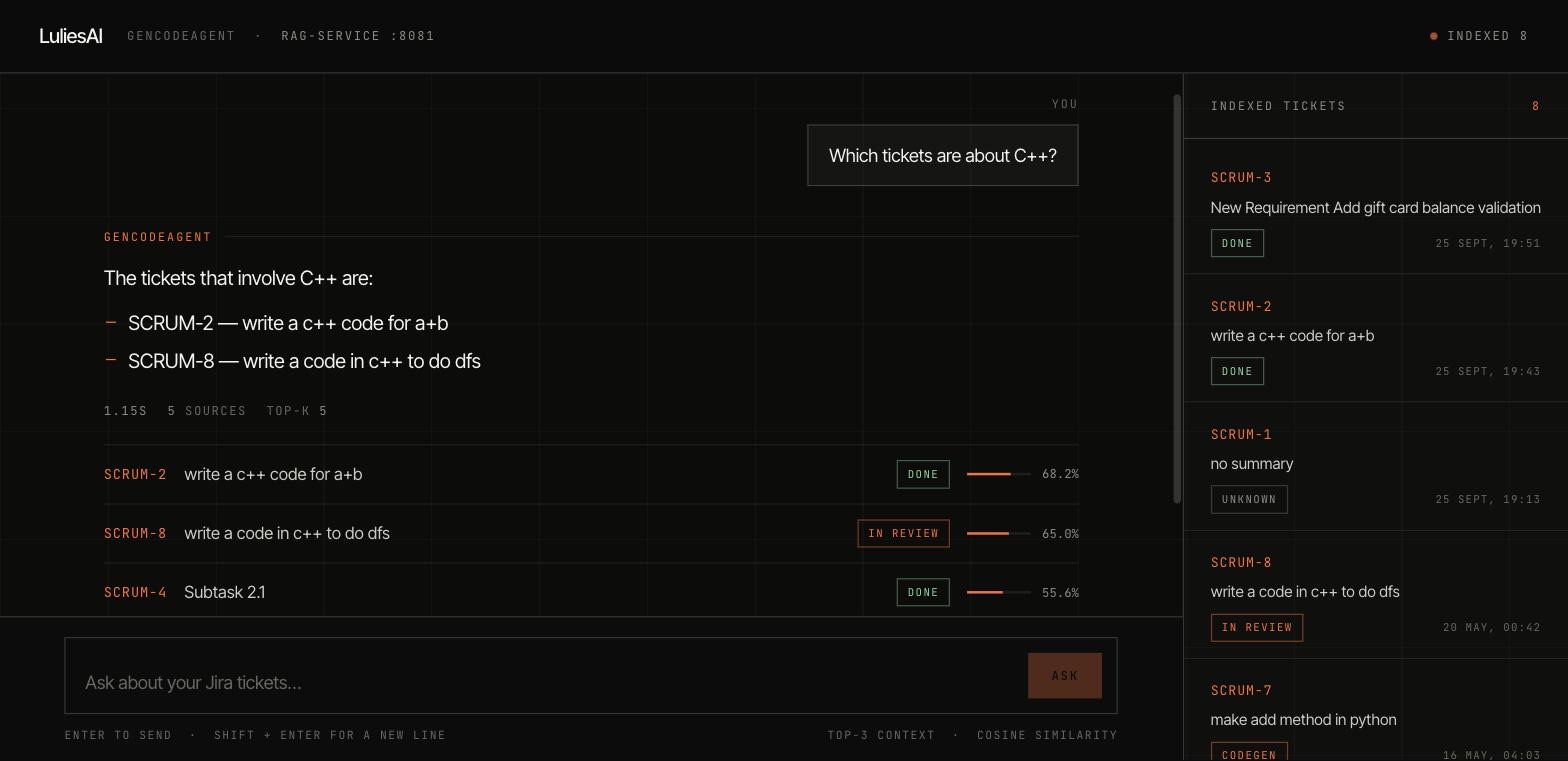
Every ticket the pipeline embeds for code-generation context is also queryable in plain language. One vector table, two consumers: it feeds the model that writes the code, and it answers the developer who asks what the project already knows.
How it is wired
- POST /api/query embeds the question with the same HuggingFace model used for indexing — 384 dimensions, so question and ticket share one vector space.
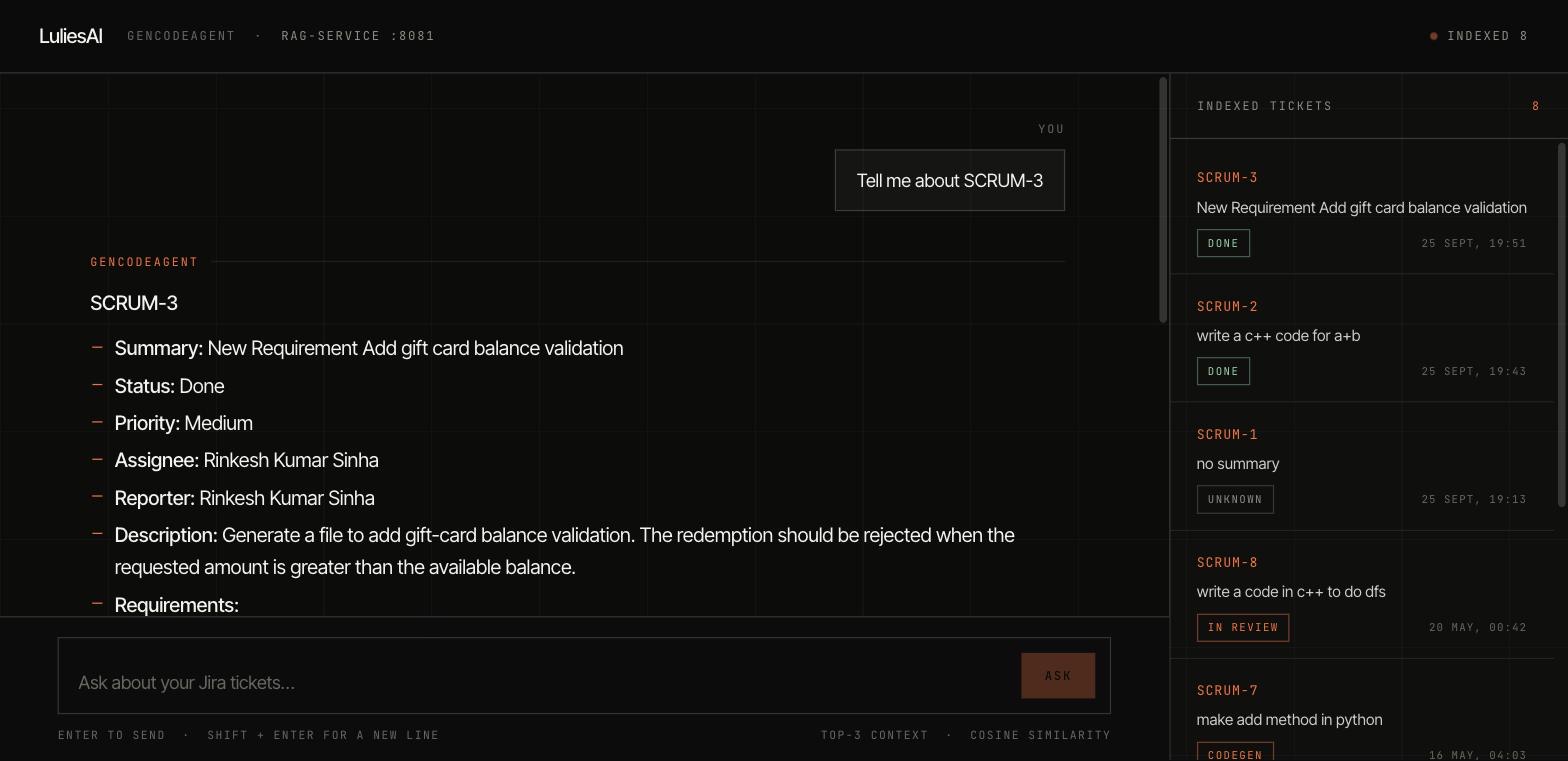
- Hybrid retrieval. Naming a ticket is lexical, not semantic:
SCRUM-3embeds almost identically toSCRUM-1. Any issue key in the question — a pasted Jira URL included — is looked up exactly and pinned to the front of the context; cosine neighbours fill the rest. - Grounding. The retrieved tickets become the prompt, and every answer ships with its sources and their similarity scores. Nothing is returned that cannot be traced to a row.
- GET /api/tickets backs the live index panel, so the console shows exactly what the pipeline has seen.
05Built with
- Java 21
- Spring Boot 3.2
- Apache Kafka
- PostgreSQL
- pgvector
- HuggingFace
- Groq
- Llama 3.3 70B
- Jira Cloud API
- Bitbucket Cloud API
- Docker Compose
- ngrok
A Jira ticket is the beginning.
The Pull Request is the output.